GYNEQUIPE
Monday to Thursday18:00 - 22:00
AddressXenias 1 & Vassilissis Sofias, Ilisia
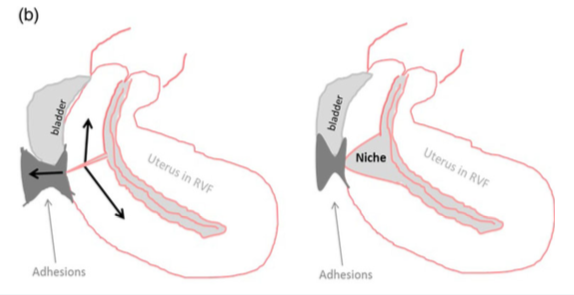
Τhe uterine scar after cesarean section in the literature is called Isthmocele. It is even met with the term“niche” meaning recess, nest. It is even met with the term“niche” meaning recess, nest.
In case of cesarean delivery, the incision point inside the uterus is a weak point, which requires special attention for the next pregnancy.
The way the cesarean section is healed at the uterine site, is multifactorial and includes the conditions under which the cesarean was performed, the way the uterus is sutured (i.e.,the stitches used) and local healing conditions which are unpredictable and vary from woman to woman. An additional risk factor is the posterior flexion of the uterus (a backward-leaning uterus).
Consequently, only a small percentage of women will experience Isthmocele after a caesarean section.
A possible rupture of the uterus during labor contractions, in a subsequent pregnancy, can endanger the life of the child and the mother herself.
Normal birth is possible after a caesarean section but the gynecologist will decide if it can be performed, as long as all the necessary conditions are met.
Beyond the period of pregnancy, cesarean scarring can create problems in the woman’s cycle, such as droplet vaginal hemorrhea and/or smelly vaginal discharge. In those cases where healing has not been done correctly, all uterine excretions stagnate at the site of the incision.
This can also be a cause of secondary chronic infertility, as all these excretions can have a toxic effect on the implantation of the embryo in the endometrial cavity and even affect the results of IVF.
The thickness of the cesarean section scar in the uterus can be measured sonographically before the next pregnancy to assess the risk of uterine rupture.
If the thickness of the scar is too thin, or the deficit too large and there is a desire for pregnancy, then surgical correction of the scar is necessary, which can now be done safely with the method of laparoscopy, with one day hospitalization only.
In cases where there is no desire for pregnancy by the woman and the problem is limited only to malodorous vaginal excretions, then it is possible to correct with the hysteroscopic method, through the natural route, with hospitalization of only a few hours.

Covering every aspect of a woman’s life

without stress and full of confidence during this special time

Minimally invasive surgery

One day diagnosis and treatment. (No touch, Diagnostic and Operative Hysteroscopy)
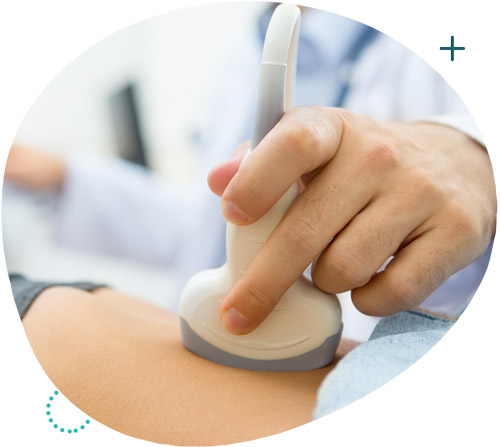
Gynaecological and obstetric scans (3D US, 4D US, Doppler US)

Urinary incontinence and pelvic prolapse treatment.

Prevention and treatment of gynaecological cancers. (International Guidelines)

Our services
Affiliated Hospitals
Affiliated Institutions
Office Hours
© Copyright 2024 Gynequipe. All right reserved

